
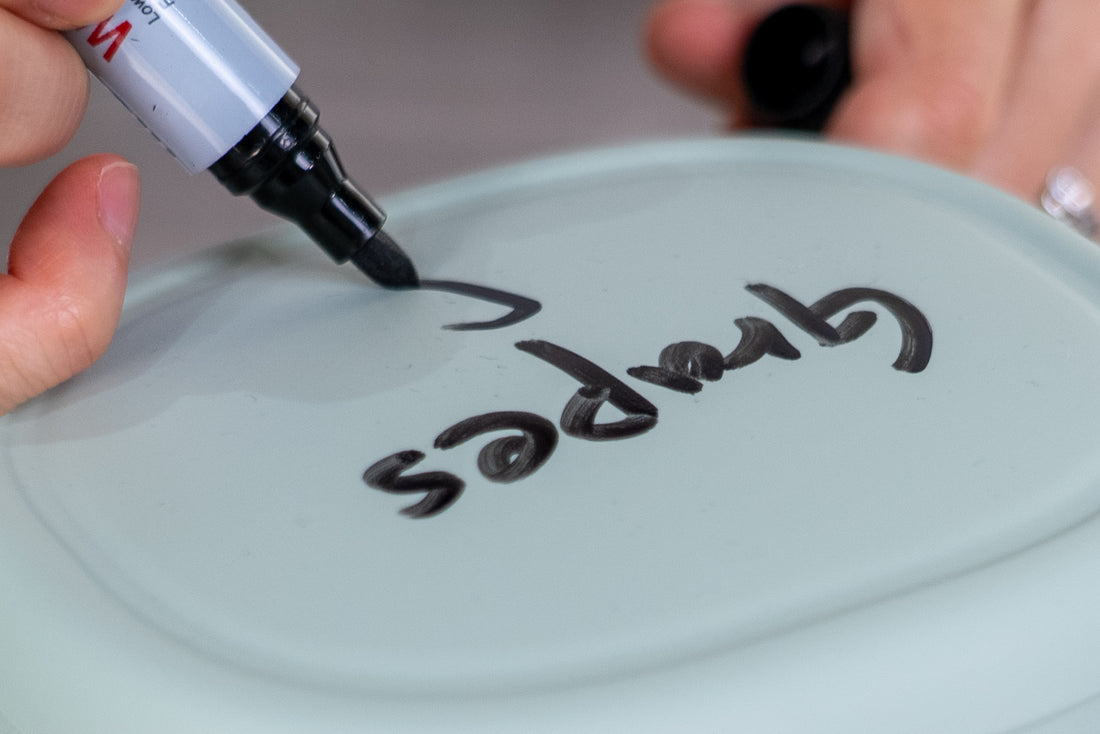
How to Label Silicone Food Containers
Share
A simple label can help you identify leftovers, keep track of freezer portions, or return a lunch container to its owner.
For silicone containers, choose a labeling method that suits the surface and how you plan to use it. Test first: marker inks and adhesive labels can behave differently on silicone.
Decide What the Label Needs to Tell You
Keep labels short and useful. Depending on the contents, include:
- The name of the food.
- The date it was prepared or frozen.
- A name for school or work.
- Reheating instructions, where helpful.
A label helps you keep track of food, but it does not replace appropriate storage and food-safety practices.
Writing Directly on the Container
If you want to try a chalk marker, check the marker manufacturer’s instructions for suitable surfaces and removal methods.
Write only on the exterior, away from the rim, sealing surfaces, and anywhere that touches food or mouths. A “non-toxic” label does not establish suitability for food contact.
Wash and dry the container first. Test a small, inconspicuous area before adding a full label, then check that the ink comes off with your normal washing method.
Some inks may stain, smear, or leave a trace. Avoid permanent markers if you want a removable label.
Using Removable Labels
Look for labels specifically intended for silicone and the conditions you need, such as refrigerator or freezer storage.
Ordinary stickers may not adhere reliably to a flexible silicone surface. Apply labels to a clean, dry exterior and follow the label maker’s instructions.
Check whether the label must be removed before washing or heating. Do not assume a label shares the container’s temperature limits.
Keep School Labels Simple
A name or initials on the outside can help distinguish similar containers. For younger children, a recognizable symbol may also be useful.
Check the label regularly for smudging, peeling, or wear. Keep decorations away from food-contact areas and surfaces used for sealing.
Clean Gently Between Uses
Follow the container’s care instructions and the marker or label manufacturer’s removal guidance.
Start with mild dish soap, warm water, and a soft sponge. Avoid sharp scrapers, abrasive pads, or solvents that are not approved for the product.
If a mark remains, contact us before trying a stronger cleaning method. Our silicone care guide is available in Blue Ginkgo Guides.
Choose a System You Will Keep Using
A food name and date are often enough. For school or work, a clear name label may be all you need.
The best approach is easy to read, suitable for the surface, and straightforward to update.
Explore Blue Ginkgo silicone food containers.
Better Design, Simpler Living.